Let’s start in the middle of the problem.
You don’t wake up one morning thinking, “I’d love to build software today.”
You wake up because something is broken, slow, or holding the business back.
Maybe your team is stitching together five tools that barely talk to each other.
Maybe reporting takes days.
Maybe customers keep asking for features your current system can’t support.
Or maybe licensing costs are creeping up quietly, month after month, until finance starts asking uncomfortable questions.
That’s when the real question shows up.
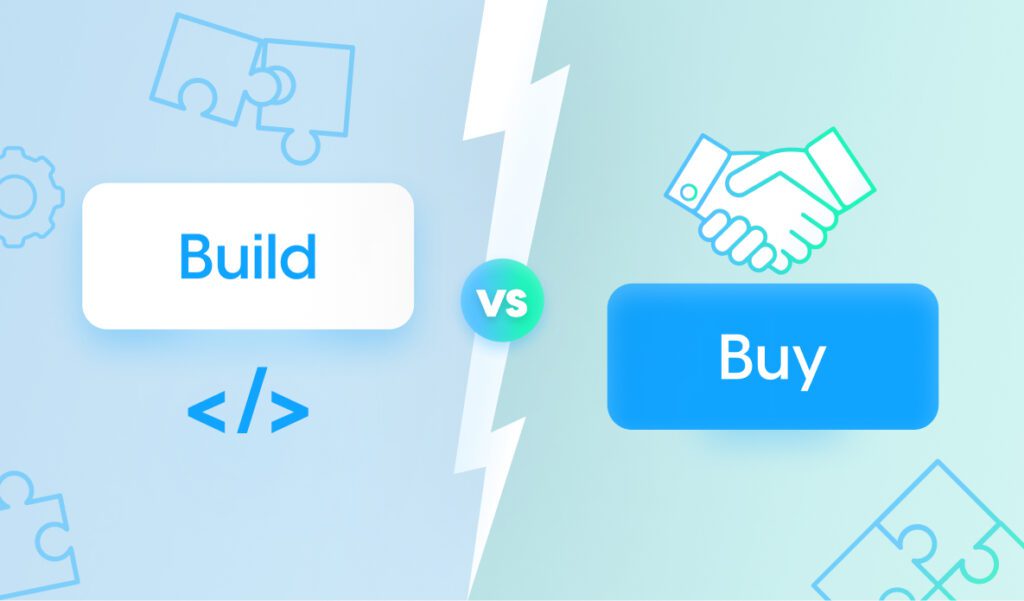
Do we build software that fits us?
Or do we buy something that already exists and move on?
There’s no universal right answer. Anyone telling you otherwise is selling something.
What matters is context. Stage. Pressure. Risk tolerance. And how much control you actually need.
Let’s break this down properly.
Why the Build vs Buy Question Keeps Coming Back
Most businesses don’t ask this question once.
They ask it repeatedly, at different stages.
Early on, buying feels sensible. You need speed. Proof. Momentum.
Later, buying feels restrictive. Workarounds pile up. Teams adapt to tools instead of tools adapting to teams.
Eventually, software stops being “just a tool” and becomes part of how your business operates.
That’s when the decision gets serious.
And expensive if done wrong.
What “Buying Software” Really Means
Buying software doesn’t just mean paying for a tool.
It means accepting someone else’s assumptions about how your business should work.
Off-the-shelf software is built for averages. For common use cases. For scale across thousands of customers.
That’s not a flaw. That’s the point.
Where Buying Makes Sense
Buying software works well when:
- Your process is standard
- Speed matters more than flexibility
- You don’t want to maintain tech internally
- The tool solves 80% of your needs cleanly
Payroll systems. Accounting tools. Email platforms. CRM at early stages.
These are not places to reinvent the wheel.
Buying here saves time, energy, and distraction.
The Hidden Trade-Off
But buying also means:
- Limited customization
- Roadmaps you don’t control
- Features you pay for but don’t use
- Integrations that only go so far
- Vendor lock-in you notice too late
At first, you adapt your workflow. Then your team starts complaining. Then spreadsheets appear. Then manual work creeps back in.
The software didn’t break.
Your business outgrew it.
What “Building Software” Actually Involves
Building software is not about control for control’s sake.
It’s about alignment.
When you build, you’re saying, “Our way of working matters enough to shape the system around it.”
That’s powerful. And risky, if you underestimate the effort.
What Building Gives You
When done right, custom software gives you:
- Exact-fit workflows
- Full data ownership
- Flexible integrations
- Control over performance
- Freedom from per-user pricing traps
You’re not waiting for a vendor update.
You’re not negotiating feature requests.
You decide what gets built, when, and why.
What Building Demands
The building also asks for:
- Clear requirements
- Ongoing maintenance
- Technical leadership
- Budget discipline
- Patience
This isn’t a one-off cost. It’s a long-term commitment.
And that’s where many businesses misjudge the effort.
The Stage of Your Business Changes the Answer
Here’s where most build vs buy debates go wrong.
They ignore timing.
1) Early-Stage Businesses
If you’re validating an idea, buying is usually smarter.
You need speed. Feedback. Learning. Not perfection.
Building too early often means spending months on software before you know if the business model even works.
At this stage, flexibility comes from business decisions, not code.
2) Growth-Stage Companies
This is the danger zone.
You’re growing fast. Systems are under strain. Teams are stretched.
Buying still feels easier, but cracks are obvious.
This is where many companies start mixing approaches.
They buy for commodity needs.
They build around their core differentiator.
This hybrid approach often works best.
3) Mature or Enterprise Businesses
At scale, buying everything becomes expensive and limiting.
Custom workflows. Compliance. Performance. Reporting. Integration.
Off-the-shelf tools start fighting your complexity instead of supporting it.
This is where building becomes strategic, not optional.
Cost: The Most Misunderstood Factor
Everyone asks about cost.
Few calculate it properly.
Buying Looks Cheaper. At First.
Monthly subscriptions feel harmless.
Until you add:
- Per-user pricing
- Feature add-ons
- API usage fees
- Premium support costs
- Integration tools
Five years later, you’ve paid far more than expected, with little to show in ownership.
The Building Looks Expensive. Up Front.
Custom software has visible costs early.
But over time:
- No per-user fees
- No forced upgrades
- No paying for unused features
- No vendor dependency
The total cost curve often flips after a few years.
Cost isn’t about cheaper vs expensive.
It’s about predictability and control.
Control vs Convenience: The Real Trade-Off
Buying software prioritizes convenience.
Building software prioritizes control.
Neither is inherently better.
The mistake is choosing convenience when control is actually what you need.
If software shapes your customer experience, internal efficiency, or competitive edge, lack of control becomes a risk.
If software is just supporting a basic function, control adds unnecessary complexity.
This distinction matters more than tech preferences.
Integration Is Where Decisions Get Exposed
Most software decisions don’t fail at launch.
They fail during integration.
Your tool needs to talk to other tools.
Data needs to flow.
Automation needs to work without constant babysitting.
Off-the-shelf software integrates well with popular platforms. Poorly with anything custom.
Built software integrates however you design it to.
If integrations are central to your operation, building often wins.
Security and Compliance Aren’t Equal in Both Paths
Buying software means trusting the vendor’s security posture.
For many use cases, that’s fine.
But in regulated industries, sensitive data environments, or complex access models, limitations appear quickly.
Building lets you design security around your risk profile, not someone else’s average.
This matters more as your data footprint grows.
Speed Is Not Just About Development
Buying software gets you started faster.
Building software adapts faster later.
That distinction is subtle but critical.
Teams often choose buying for speed, then suffer slow change cycles when the business evolves.
With built systems, iteration speed improves once the foundation is in place.
The question is when speed matters more: now, or later.
What Many Businesses Get Wrong
Here’s what we see repeatedly.
- Building when buying would have been enough
- Buying when building was inevitable
- Choosing tools without mapping workflows
- Underestimating long-term costs
- Overestimating internal capacity
The worst outcome isn’t choosing build or buy.
It’s choosing without clarity.
A Practical Way to Decide
Instead of asking “build or buy,” ask these questions:
- Is this software core to how we compete?
- Will our workflow change significantly over time?
- Do we need deep integration with other systems?
- Is data ownership critical?
- Can we maintain this long term?
If most answers lean yes, building deserves serious consideration.
If most answers lean no, buying is probably smarter.
Hybrid Models Are More Common Than You Think
Many strong businesses don’t choose one side.
They buy standard tools.
They build custom layers on top.
They replace pieces gradually as needs evolve.
This reduces risk while maintaining flexibility.
It’s not a compromise.
It’s pragmatism.
The Human Factor Matters More Than the Tech
Tools don’t fail on their own.
People struggle with tools that don’t match how they think or work.
If your team constantly fights the system, productivity drops. Morale drops. Workarounds appear.
Software should reduce cognitive load, not add to it.
That’s true whether you build or buy.
Final Thought
Build vs buy is not a technical decision.
It’s a business one.
The right choice depends on where you are, where you’re going, and how much control you need along the way.
Short-term convenience feels good.
Long-term alignment feels better.
Choose with your future in mind, not just today’s pressure.
FAQs
Is custom software always better than off-the-shelf tools?
No. Custom software is better when your needs are unique or evolving. Standard tools work well for common, stable workflows.
When should a business switch from bought software to custom-built solutions?
Usually when workarounds, integrations, and costs start outweighing the convenience of the original tool.
Is building software risky for small businesses?
It can be, if done too early. Timing and scope matter more than size.
How long does it take to build custom business software?
It depends on complexity. Simple systems take months. Mature platforms evolve continuously.
Can businesses mix built and bought software?
Yes. Many successful companies use hybrid setups to balance speed and control.
What’s the biggest mistake companies make in this decision?
Choosing based on cost alone, without considering long-term impact.